Thursday, February 27, 2014

Dear Esther, an artistic experience

The video game, Dear Esther is an artistic simulation of the world that tells a story of a shipwreck on the coast of Britain. It has been argued whether or not the story-driven “video game” should be or should not be considered a “game.” Its lack of interactivity and player-engagement recontextualizes what Dear Esther actually is. The artistic creation, the value of a realistic simulated world and the serious attention to detail make Dear Esther more viable to be called art rather than an archetypal video game.
Dear Esther begins with the narrator introducing the story, “Dear Esther, the morning after…” As he begins telling the story, epic music plays in the background and the player is introduced to the plot of the shipwreck. The human player plays in the first-person, making the game a simulated experience. The player meanders around the area by clicking one key to move. A gray, eerie sky covers a dark ocean among the cliffs of Britain and led by a light, the player is able to wander around, look up, look down, turn around in every direction to observe the surroundings. But that is indeed the problem in which players have— that the player can only observe rather than be able to interact with the mysterious objects and happenings around them. A review of Dear Esther seems bothered by the limited interactivity,
“Dear Esther asks nothing of you but to occupy this world. There's very little interactivity; a torch comes out automatically in the dark, but that's pretty much the limit. You can't help but imagine a version of this game that lets you touch and feel, picking up pebbles on the beach to throw into the sea or leafing through old books in an abandoned bothy. You feel the urge to stop and stare, to wander off the path and explore, but there's always the awareness in the back of your mind that there's not really anything to find” (MacDonald). It seems as though Dear Esther could have easily been a thrilling and interactive game just with a few slight changes to allow the player to be more involved with an objective of the game. Solely because the player holds down a key the entire game to move the character around in the first person perspective doesn’t seem to be enough interaction and game-play for Dear Esther to truly be considered a game, but more accurately considered interactive art. Another review suggests that, “Dear Esther is such a purely audio/visual experience that I have to conclude it would be better as a short film” (Pinsof) This statement holds true for many players, furthermore making the game more accurately called interactive art.
Dear Esther is an experience. The player participates (somewhat) in events through observing, perceiving a simulated reality, and “living” as the first-person player in the game. The experience becomes an artistic one— the players becomes lulled into the story of “Donnelly,” the legend of the hermit, as the first-person perspective of the player lives through the adventure navigating the cliffs and oceanside of Britain. An outstanding amount of detail and thought had to have been put in to the creation of this game— attention to the beautiful realm, contextual atmosphere, and setting. The waves crash against the shore as the player walks the path that ascends the cliff, a gull flies overhead, each footstep makes a sounds, sunlight peeks through the cloud cover in the sky. This is as well as the soothing sound of the narrators voice pulls the player into the game making this game seem to be an entirely artistic experience— one can’t help but be mesmerized. Rather than a game, another gaming reviewer recalled Dear Esther to be a, “Slow paced experience more than a game praised for the way it adapted first-person exploration to tell a complex tale of grief, illness and loss.” (Thursten) Having a personal experience is part of what defines art as art. Art is often ambiguous and subjective to the individual whom is viewing it. Dear Esther is similar, in that every individual player may have a different perspective and experience of the game. The game offers symbolism, parables, metaphors, symbols, and a mysterious story that every player will have a different experience and perception. 
The game design of Dear Esther, as well as the artistic experience of playing the game reinforces that Dear Esther is more art, rather than video game. The game is led by the narration of a story, there aren’t any puzzles for the player to solve, and the lack of interactivity makes it a difficult case to claim this game as an actual game. Narrative and art takes precedence in Dear Esther making gameplay more of an artistic experience. The experience, appreciation of the story, and call for imagination are the ingredients which make the claim that Dear Esther is art more so than a video game. 


MacDonald, Keza. "Dear Esther Review." Rev. of IGN. n.d.: n. pag. Web

Pinsof, Allistair. "Review: Dear Esther." Rev. of Destructoid. n.d.: n. pag. Web.

Thursten, Chris. "Dear Esther Review." Rev. of PC Gamer. n.d.: n. pag. Web.

Dear Esther: A Piece of Modern Art

“Now to everyone’s favorite unit…modern art!” my teacher announced reaching for her laptop to change the PowerPoint slide. “We will begin with readymades.” The screen briefly flashed white and, in painfully slow motion as is custom with slideshow presentations, a picture materialized on screen.
Sitting a few rows from the back in a cramped theater-style seat at the Frick Fine Arts Building, I struggled to see what I was looking at. Is that a urinal?
            “In 1917 Marcel Duchamp submitted this piece of artwork to the annual exhibition hosted by the Society of Independent Artists. Duchamp called this piece of art ‘Fountain,” and, over the next few years, it would become an iconic piece of modern art.” She paused, and looking out at what must have been two hundred open jaws, clarified, “And yes, it is a urinal.”
Good, let’s just call everything art then.
            My point here is that, regardless of what definition we conjure up on Google, everything is art. In the most simple of terms, art is subjective. Art is anything that appeals to the senses. Art includes dance, music, film, books, television shows, paintings, sculptures, and, yes, urinals. Sometimes art is harder for certain people to sense, for instance me and the white ceramic latrine.
            Luckily, it was not difficult to view Dear Esther as art because of its strong resemblance to literature. Books and writing are traditional extensions of art. And if you disagree that literature is not art, then you might agree that poetry is art, and Dear Esther is certainly poetry as well. Dear Esther is digital literature, and therefore it is art. 
            Dear Esther is nothing more than a digital book – imagination is replaced by island scenery; pages are replaced by the digital framework of cave walls and rocky paths; the reader is engaged with the keyboard rather than a physical book (or eReader, or Nook, or Kindle, or iPad). Through a series of monologues, the narrator delivers the story and introduces several characters – Donnelly, Jacobson, Paul, the hermit, and Esther. In every piece of literature there is conflict, just as in every piece of art there is tension (think back to the urinal and the extreme tension that resonates in that piece of art). In her review published in 2014, Keza MacDonald describes the conflict/tension of Dear Esther. MacDonald writes, “Dear Esther is the story of a shipwrecked castaway on a remote Hebridean island, delivered through spoken lines of sumptuous, disconnected prose as you walk around the detailed landscape.” As the “ghost story” unfolds the player learns about a drunken accident and about the suffering and eventual death of the island’s other inhabitants. Every piece of literature, at least every piece of good literature, has action. In his 2012 review of Dear Esther, Allistair Pinsof sums up the action perfectly: “All you do in this game is walk. You literally hold down the “W”-key for 70 minutes -- even ducking, the only other action, is automatic.” The action may be boring and monotonous, but there is action. Dear Esther is an exploration; the action is therefore exploring and adventuring in order to reach some end goal or final destination.
            One final argument that confirms Dear Esther is a piece of literature: if you typed out the narrator’s monologues, you could follow along as a reader. The digital medium in which Dear Esther is delivered merely enhances the reader’s immersion. Where traditional books provide solely narrative surrounding and paintings provide solely visual surrounding, Dear Esther simultaneously provides a narrative surrounding and a visual surrounding. Dear Esther is simply an extreme picture book.

            While Dear Esther certainly functions as art, its function as a game is more obscure. I hoped to second the argument put forth by the game itself: “why not everything and all at once!” However, I found that Dear Esther does not function as a game. My first step in analyzing whether or not Dear Esther is a game, was to define the general concept of a “game.” The most encompassing definition I found was: “A game is a rule-based system with a variable and quantifiable outcome, where different outcomes are assigned different values, the player exerts effort in order to influence the outcome, the player feels emotionally attached to the outcome, and the consequences of the activity are negotiable” (Whitson). According to this definition, as well as many other definitions I read, the primary requirements of a game are:

1.      Rules

2.      A variable and quantifiable outcome

3.      Player influence over the outcome

4.      Emotional Attachment to the outcome  

Dear Esther has rules – the geographic bounds of the game are the rules. The definition of a “game” expands to define the role of rules in a game: “The rules construct the possibility space of the game (i.e. what players can and cannot do) – they are “affordances” that permit certain actions while prescribing and preventing others. By accepting to play, players consent to the constraints posed by the rules. What makes “digital games” different from traditional games (e.g. card games, board games, etc.) is that the rules are embedded in the hardware and the software of the game, thus freeing players from having to enforce the rules themselves” (Whitson). When you arrive on the deserted, down-trodden beach you can either walk along the rocky coastline or investigate the house. Or I suppose you can stand still and do nothing, but those are the only options. From there you walk up the incline towards the lighthouse. In the cave, there is only one way to move…forward. In fact the walls of the cave are the strictest rule because they provide the most limited range of choice – when you are walking along the beach at the beginning of the game you can at least walk in the water, on the sand, or on the rocks, but in the cave you can only move straight forward.

            Dear Esther has an outcome: after about two hours of walking, you climb a seemingly endless stair-lined incline, reach the top of the lighthouse, and “take flight.” The player, I would argue because at least I did, has an emotional attachment to the outcome. However, because the player has no influence on the outcome, and because there is only one possible outcome (excluding the possibility of not finishing the game as an outcome) Dear Esther cannot be considered a game.
 
Works Cited and Consulted:
MacDonald, Keza. “Dear Esther Review”. 13 February 2012. Web. <http://www.ign.com             /articles/2012/02/13/dear-esther-review>
Pinsof, Allistair. “Review: Dear Esther”. 13 Febraury 2012. Web. http://www.destructoi   d.com/review-dear-esther-221082.phtml
Whitson, Jennifer. “FCJ-106 Rule Making and Rule Breaking: Game Development and the           Governance of Emergent Behavior”. The Fibreculture Journal Issue 16 2010. Web.            <http://six teen.fibreculturejournal.org/rule-making-and-rule-breaking-game-    development-  and-the-governance-of-emergent-behaviour/>

A Work of Art, But Not a Game

        The prevailing perception of a video game resembles software like the Call of Duty franchise by Activision, a combat heavy, fast paced, and aggressive experience focused on excitement and film-like experiences. These games care more about how many guns there are to use than leaving the player with an emotional impact. On the flip side of this perception is the idea of more cerebral games. This type of game places more importance on player interaction with the environment, and creating an emotional impact within the player over how many people the player has virtually killed. Games of this nature include items like Journey or Flower, both by thatgamecompany. Tossed into this divide of definitions is the game Dear Esther, by developer The Chinese Room. Initially developed as a mod to the popular Half-life 2 game (by Valve), Dear Esther sells itself as a game, but is a wholly different experience than a modern military shooter. Dear Esther is in fact a video game only because the term video game is inherently vague, but is better defined as an “interactive experience”, while still counting as art.

        According to the Encyclopedia Britannica, a video game (electronic game) is defined as “any interactive game operated by computer circuitry” (Electronic Game) and later defines game as “universal form of recreation generally including any activity engaged in for diversion or amusement and often establishing a situation that involves a contest or rivalry” (Game). What’s notable about this definition about a video game is that it makes no mention of combat, or fast-paced action, or even a mandate of “winning the game”. A video game just needs to be interactive and played on an electronic device. By this definition, Dear Esther must be a video game, because that is exactly what it does. The program is played on a computer, and is interactive by way of allowing the player lead his or her own way through a mysterious environment at their own pace, and discover parts of the island and the story behind the island as they go on. Dear Esther is a video game.
New Environments in Dear Esther
The sole issue with using the limited Britannica definition is how overly vague it is. By this definition, even Microsoft Word counts as a video game, as long as writing counts as an interactive and recreational experience (it does). By technical merit, the

        Moving away from the encyclopedic definition, the better way to evaluate the status of Dear Esther is by its critics and commentators. The issue leveled by many reviewers of this game is that the mode of interaction (limited to walking around) is not enough to quantify this as a game, a position that I agree with. As Allistair Pinsof stated in the review for Destructoid: “All you do in this game is walk. You literally hold down the “W”-key for 70 minutes -- even ducking, the only other action, is automatic. At one point, my finger became so tired that I mapped the “Forward”-command to my right-mouse button. […] The bigger problem with Dear Esther is that it revolves entirely around moving forward without providing any momentum, incentive, or even a clear path (at times).” (Pinsof). The criticism here is that just walking to reveal contents of the story are not enough; a game should have a more active form of interaction. Dear Esther’s entire game is based on the character being washed up on an island, and then navigates the island, while a narrator reads letters addressed to Esther, which describe the history of the island, what the narrator was doing in the island, and what may have happened to Esther on the mainland, all while the player navigates the character through the strange environment, full of strange paintings, discarded cargo, derelict ships, and rotting chemistry textbooks.  Player interaction is limited to movement, and the only real choice the player makes is how long to explore each particular location before moving on. Even crouching or turning on a light, hallmarks of exploratory video games, are left to the software’s control, not the players. The only impact the player has on the game is on how long the game lasts. Beyond that, all control is in the hands of the program. The game focuses on the player’s experience in navigating strange and beautiful environments, while being led on to the next area through a haunting score and the desire to reveal more of the story behind the game through the narrator. It lacks the kill-kill-kill mentality of shooting games, or even the mind-bending nature of puzzle games. The greatest parallel I can draw to Dear Esther is the game Amnesia, where the interactivity of the game is limited to walking around in a horror-movie type environment. In both cases, the plot and the emotions evoked in the player are the only things keeping the player moving forward, there is no other incentive to continue. The game only lasts so long as quickly as the player moves through the content. Keza MacDonald of IGN stated “As a piece of visualized fiction, Esther is a wonderful thing, but judged purely as a video game it has obvious failings” (MacDonald). MacDonald believes that the limited interactivity made it more akin to a choose-your-own-adventure novel, a work of interactive fiction, but not a game. That mirrored my experience as well. Playing the game, I felt as if I was more along for the ride, more so than I was actually playing. The game was highly immersive, due to the fantastic level design and music, but I never felt as if I was playing, just watching a movie where I controlled the camera. Paul Goodman, on the review for the Escapist, stated: “When it all comes down to it, Dear Esther is a game that puts story over gameplay, and in many ways successfully creates a unique experience. That being said, Dear Esther isn't for everyone. If you're the type of gamer who feels most comfortable with a laser assault rifle at your side, then you might not enjoy what makes Dear Esther unique. If you're the type who believes that games can be art or tell an interesting story, then Dear Esther may be more your style” (Goodman). And that’s exactly what occurs here. The game makes sure the story and exploration is the priority, with the requirement of how “game”-ey it feels as a secondary concern, and an opinion left up to the player. Christopher Franklin (Campster), a video game critic, made the video “That’s No Moon…”, wherein he discusses the game/not-a-game dichotomy, stating that in the interest of fostering variety in digital experiences, defining a game is only important to the person playing it, and less about the mechanics of the game (Franklin). Choosing to say Dear Esther is not a game is just based on personal experience on what a game is to you, simply because there are too many varied metrics to define what a video game truly is. For me, I believe that Dear Esther is not a game, just because the player has no impact on the outcome, only on how quickly the end comes. It is a wonderful experience, but not interactive enough to qualify as a game.

        That being said, stating the game is more of an “interactive experience” more so than a real video game does not preclude it from being actual art. The work put into the game, including level design, music, and scripting is top notch, and the program is really able to evoke emotions in the player. By the end of the game, I felt truly sad for the narrator, who seemed to slowly drop into madness, wonderment at what happened at the island, and awe for the amount of painting/graffiti the narrator was able to do, in such a stylistic form. The game was able to evoke in me a sense of mystery, as the cave drawings that went from chemical structures, to electrical circuit diagrams, to depictions of neurons were merged into single drawings, and that, combined with the biblical quotes that described Paul’s transformation on the road to Damascus, left me intrigued.Dear Esther stands as art because it represents an experience just as immersive and emotional as any movie or painting. Looking at video games as a whole, the games that are easier to describe as real art are not the games that rely on shooting and killing as the sole mechanic, but the games that place more importance on how the player interacts with the software, and the emotions that come from the experiences. Going back to the example of Flower and Journey, both of these games rely on how the player interacts in beautiful settings. The importance is on finishing the content, yes, but also on the emotions evoked. Flower has the player controlling the wind, and with a goal of pollinating the environment, getting all the flowers to bloom.
Strange Drawings in Dear Esther
The game is art by its ability to evoke emotions in the player, and that was certainly accomplished. Furthermore, the combination of fantastic visuals and music independently count as art. To create a world as immersive as this, with a score that allows prompts you to move forward,
Flower Gameplay, from http://www.indiegames.com/images/timw/flower2b.jpg
On the surface, it’s not the most captivating of experiences, but the combination of chiming music, visual cohesiveness, and the peaceful nature emotion of the game when finishing a level are wonderful. Journey takes a different approach. It has similar art style and wonderful music, but it also takes become art because it is able to connect two different people in a meaningful manner, without any direct communication between the two people.
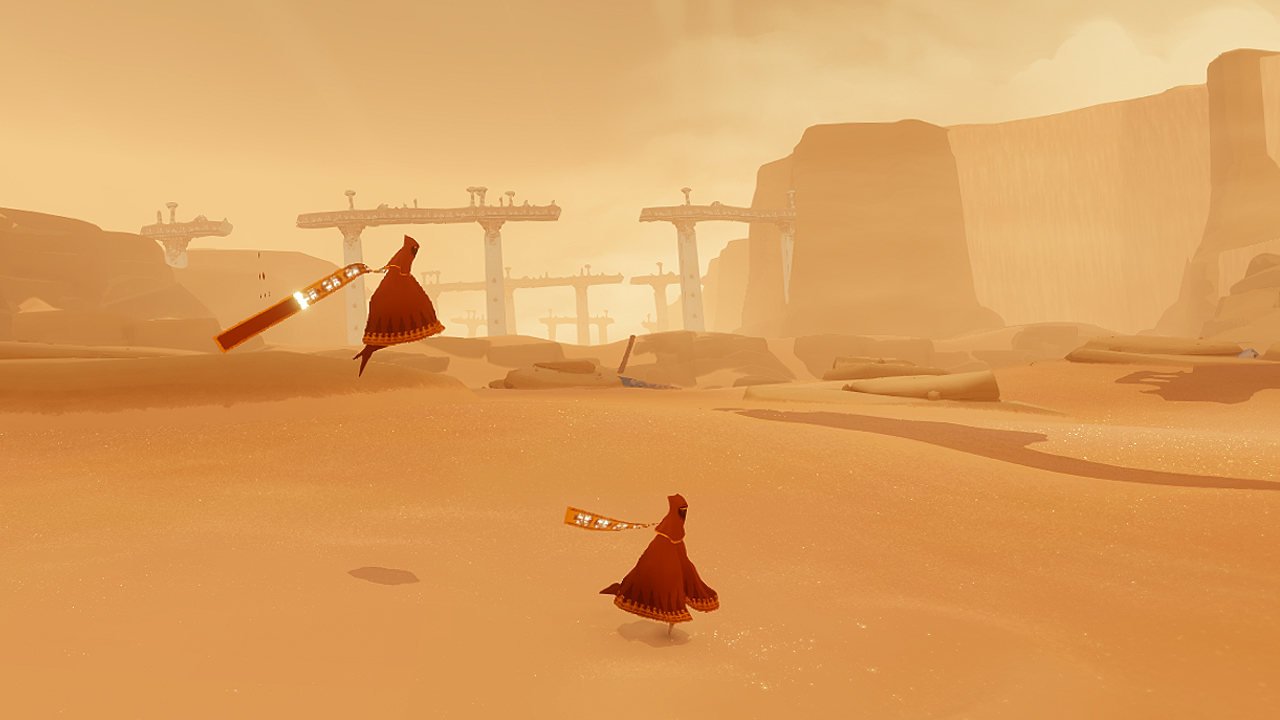
Journey Gameplay, from http://www.theaveragegamer.com/wp-content/uploads/2012/02/Journey-Co-op-Barrems.jpg
You work to finish a goal communicating only by action, and yet, still feel a sense of companionship by the end of the game. In both cases, the games are art because they are able to connect with the player, on a basic quality of design, and on an emotional level. Dear Esther may not fit into the traditional definition of a game, but it is art.

        The distinction between game and not a game is highly personal, as it speaks to the individuals definition to describe how much interaction, and what method of interaction, are appropriate to define a game. To me personally, Dear Esther is not a game, but more of an interactive experience, because the player interaction is minimal on its effect on the software, but the software is able to completely immerse the player into the environment. Once again, Dear Esther is more like a movie with the camera controlled by the player than a full on game. However, even if Dear Esther is not a game, it can still be art. The software deftly manipulates the emotions of the player, and is able to evoke true feelings of wonderment, mystery, and sadness through the use of music and level design. Dear Esther is not game, but it is clearly a work of art.


Works Cited

"electronic game." Encyclopedia Britannica. Encyclopaedia Britannica Online Academic Edition. Encyclopædia Britannica Inc., 2014. Web. 27 Feb. 2014. <http://www.britannica.com/EBchecked/topic/183800/electronic-game>.

Franklin, Christopher. "That’s No Game…." Errant Signal. N.p., 16 Feb. 2013. Web. 27 Feb. 2014.

"game." Encyclopaedia Britannica. Encyclopaedia Britannica Online Academic Edition. Encyclopædia Britannica Inc., 2014. Web. 27 Feb. 2014. <http://www.britannica.com/EBchecked/topic/224863/game>.

Goodman, Paul. "Dear Esther Review." The Escapist. N.p., 24 Feb. 2012. Web. 25 Feb. 2014.

MacDonald, Keza. "Dear Esther Review." IGN. N.p., 13 Feb. 2012. Web. 25 Feb. 2014.


Pinsof, Allistair. "Review: Dear Esther." Destructoid. N.p., 13 Feb. 2012. Web. 25 Feb. 2014.

All images are screen-shots of my own playing, unless otherwise noted.

Silent Video Game.

                For decades, the world has been plagued with video games that revolve around great deals of violence and high intensity. Unlike most popular games to date, Dear Esther refrains from the bloodshed and high power that many modern day gamers are used to. With well composed music, a deeply engaging narrative, and visuals that looks almost real, Dear Esther is a prime example of a type of video game that can be defined as interactive storytelling while also falling in the same category as ‘just another’ video game.
                While playing Dear Esther, the gamer is immediately introduced to the incredibly slow pace and dense, confusing narrative. These might hold back the drama of a video game, but they give the player more time to take in the dynamic visuals. Keza MacDonald, a game critic and self-proclaimed fan of art, praises Dear Esther as “it doesn't need puzzles or mechanics to draw you in”. The story alone drives the player to want more and see more, like many other games. The more the player sees, the more the story is told. Just like almost every other video game that has a story, the player must navigate through terrain to uncover more of the tale. The game intensifies both narratively and visually, when the character finds itself inside the paint covered caves. The chemical formula of alcohol can be seen plastered haphazardly on many of the cave walls. Although not directly stating it, the gamer can infer that someone had died at the hands of a drunk driver.
                To strip this game of its classification of a video game is ludicrous. The Merriam-Webster dictionary defines a video game as “an electronic game in which players control images on a television or computer screen”. Nowhere in that definition does it state that a game needs to be high action, shooting, car stealing, drug laundering, or even relatively easy to understand. With such a vague definition, Dear Esther is exactly within the parameter. Although the game lacks voluminous drama, the player deals with an extremely confusing storyline that may seem impossible to understand, but once the game is through the gamer has a plethora of ideas and wonders. Stitching together the narratives provides the player with an engaging atmosphere leading them to want more. The absence of headshots in this game does not make it any less engaging.
                Allistair Pinsoff gives the game high acclaim for the gorgeous music and splendid visuals, but remarks that Dear Esther “feels lazy”; but is wonder and intrigue not supposed to be present in modern day video games? Are video games not allowed to provide an intricate story without the ability to run but the ability to make one pace in their mind? The harsh criticism that faces Dear Esther is comparable to initial criticism which faced American composer, John Cage’s piece, “4’33”. Cage’s composition is nothing but silence for four and a half minutes. Although it seems confusing, many musicians now consider this to be an influential composition. Just because the piece lacks any true sound to come from any instrument, it tries to bring further meaning to what music is. This seems to be what the creators of Dear Esther did. It expands what a video game really can be. Both game and composition are far from the norm, but both fit the definitions of what they aspire to be.

                To completely remove the label of “video game” from Dear Esther would be an injustice. The game requires thought, time, initiative, and motivation to piece together the wildly fragmented story. Like many other games of this time, it gives subtle hints and clues that require the gamer to do more and focus more than if they were merely shooting a gun. Yes, Dear Esther is different than most games but at the end of the day it still is just that, a game. 

Prompt 1: Reviewing the Reviews

Dear Esther is beautiful and poetic. It is a mix of organic and artificial. It is an exploration. But is it a video game? According to the Oxford English Dictionary, a video game is, “a game played by electronically manipulating images displayed on a television screen”. If we look at Dear Esther, and only this definition of a video game, than yes it is that. Urban Dictionary (a dictionary website comparable to Wikipedia) defines a video game a bit differently. There are pages and pages of definitions under the term, some of which are quite similar to the Oxford English Dictionary’s definition, and some of which are entirely unique from it. For example, one submission reads, “A program that is more than a form of entertainment. It offers us an escape from the dullness of reality, a place where we can do things we actually can't. Grand Theft Auto III lets you buy whores, kill them, and get your money back.” This definition, and its somewhat crude example, offers a more abstract understanding of video games. Another entry says, “Something that you do for interactivity, not for looking at graphics. Who cares for graphics? Mario, Pac-Man, and Sonic are great and their graphics suck! I like to play with a video game, not a DVD player.” These less technical and more cultural definitions of video games suggest what people want from a game, not just what it is.
            I desperately want to like Dear Esther. I’m not very good at video games. I don’t play them enough to have the hand-eye-coordination necessary to advance and win, so I get bored. Dear Esther requires little, if any, skill. Really all you need to actively do is continuously press the ‘w’ key and direct the mouse left or right. It’s too simple though. It’s so simple that it’s mind-numbing, which takes me right back to being bored. The graphics are beautiful, and the story is intriguing – at first. The mystery makes you want to explore the eerie island and discover who this Esther is, but the ‘game’ never gives you answers. It isn’t satisfying.
Dear Esther is more a sophisticated picture book than a video game. What it lacks and what it does magnificently are both its downfall. The balance of artistry and activity is off. If the ‘video game’ was more video, it would be beautiful and poetic, but the interactivity (i.e. pressing down the ‘w’ key) is distracting from the story. A review of the game by Allistar Pinsof breaks down the benefits of making the narrative interactive. He writes, “For one, you can explore this world with your own eyes. You can also explore parts that aren’t worth exploring: Pathways that lead nowhere, caves with the same assets copy-and-pasted, and dead-ends that will make you curse the game’s painfully snail-paced walking speed.” If the ‘video game’ were more game, it would be an intriguing mystery to solve, but the lack of control and interaction with the environment makes it too easy to be enthralling. The mystery of the island, the letters, the motorway, Esther all attempt to draw you in, but there are no rewards. You never pick up anything, you never reach a definitive clue, and you never find any answers. You cannot sit back, listen, watch, and interpret; yet also you cannot engage. In Pinsof’s review he says, “The problem with Dear Esther is that it never uses its resources as interactive-fiction to good effect…The bigger problem with Dear Esther is that it revolves entirely around moving forward without providing any momentum, incentive, or even a clear path (at times).”
Another review by Keza MacDonald focuses more on what Dear Esther has to offer and examines it as an experiment. He also offers details about the game that are unclear while playing and only learned if you do further research. He says, “The writing is unashamedly florid, flitting all the time in an unsettling way between past and present, and usually addressed to the eponymous Esther, whose identity becomes clear as time goes on.” I disagree. When does Esther’s identity become at all clear? Later on he says, “Still, it's impressive Dear Esther doesn't need puzzles or mechanics to draw you in. The strength of the writing and the world alone is enough.” Again, I disagree. Granted I only played the game once, but I carefully observed and took notes during. Most likely I would discover more details and find a bit more clarity playing the game a second time through, but I don’t think I would find it any more interesting. Although I disagree with MacDonald’s opinion of the game, I do think looking at it as an experiment is useful. Dear Esther is trying to extend the sensual stimulation of videos through the interactive nature of games. It is both video and game and fits the traditional definition. However, when we look more closely at a cultural definition of what society wants from video games, it fails. Whether people want an escape from reality or an interactive game apart from the quality of graphics, Dear Esther’s confusing narrative and mindless interaction make it disappointing. So yes, Dear Esther is a video game, but it is flawed.
Works Cited
MacDonald, Keza. "Dear Esther Review." IGN. IGN Entertainment, 13 Feb. 2012. Web. 26 Feb. 2014.
Pinchbeck, Dan. Dear Esther. Valve, 2012. Computer software.
Pinsof, Allistair. "Review: Dear Esther." Destructoid. Game Revolution, 13 Feb. 2012. Web. 26 Feb. 2014.
"Video Game." Oxford English Dictionary. Oxford University Press, 2014. Web. 26 Feb. 2014.
"Video Game." Urban Dictionary. 2014. Web. 26 Feb. 2014.

Friday, February 21, 2014

Instructions for Self-Evaluations

These are due before class next week. This really isn’t very complicated, but I try to be as specific as possible to avoid misinterpretations.

There are three components to the self-evaluation. You will evaluate yourself on your participation in class, on your participation in the weekly short blog entries due the day before class, and on your participation in commenting on one another’s work. You will evaluate yourself on a five point scale for each category. The criteria are as follows, for each category. Please read the criteria, and send me an email before our next class, which includes the name of each category and your self-evaluation for that category. You may include a paragraph or less commenting on your own work. You may give me links to your best work for the weekly short blog and/or commenting on the work of others. These links are required if you are giving yourself a 4 or 5 in that category; you should be able to easily point out an example of your own excellent work.

In-Class Criteria

5: You always come to class, always participate multiple times, and your part in the discussion is productive (for instance, you might regularly move the overall discussion in a new direction).

4: You come to class, always participate at least once in a given session (alternatively, you might have the occasional off class, but otherwise perform at the 5 level), and your participation is consistently productive.

3: You come to class, and usually have something to say in the course of the session. The value of your participation might be inconsistent, or you might have had several silent classes.

2: You rarely participate, but you pay attention, and occasionally have things to say.

1: You rarely or never participate in class.

“Question” Blog Entries

5: You always do the blog entry, you always put some thought into it, and your work is invariably productive; you would feel comfortable writing a full essay on at least some of these ideas. Your ideas might often show up in class (hopefully with your name attached to them).

4: You haven’t missed any weekly blog entry. While the quality of those entries might vary (and their length probably does), and while only a few of your ideas might have come up class, you feel like some of them could have been the basis of a discussion.

3: You have missed no more than one weekly blog entry. The quality of those entries may be somewhat variable.

2: You do your blog entry more often than not, but may have missed more than one; when you do it, its quality may be inconsistent.

1: You usually don’t do the blog entry at all.

Comments on the work of others

5: You always make your weekly comment on another person’s blog entry. You always put thought into your comment, and you always productively focus on their overall argument, without getting wrapped up in details. You have at least a couple paragraphs of coherent thoughts.

4: The same as 5, except you might have missed an entry, or you might sometimes wander in your focus, or you might have done one or two of them in haste. Generally, though, you offer specific, focused, useful advice.

3: You usually remember to make your weekly comment, but they are often short and/or unfocused on their argument. You might, for instance, usually focus on grammatical or mechanical issues instead of their argument, or you might simply often praise the other person, without offering much in the way of constructive advice.

2: You have commented on others’ work, but you sometimes forget to do so, and you don’t put much effort into it when you do.

1: You don’t usually comment on others’ work.

Comments / questions on Dear Esther & Marcuse

Post your questions/thoughts as comments to this post.  Again:  a paragraph is fine, or a couple if you feel so moved.  You are posting on a question, problem or topic of your choice.  Citing a particular passage is recommended but not required.

Dear Esther & Marcuse Prompts

Note: citing your texts is always a good idea. When dealing with video games, I recommend learning how to take screen shots and/or video, and using it appropriately.

Prompt 1: Reviewing the Reviews

I find the reviews of Dear Esther rather interesting, both as ways of thinking about the game and as evidence that there is intelligent life among video game reviewers.

Read the following reviews; you may read others as well, if you wish.

http://www.destructoid.com/review-dear-esther-221082.phtml

http://www.ign.com/articles/2012/02/13/dear-esther-review

Using at least these two reviews to help you articulate your viewpoint (you may have use for either Portal or Zork as well), define/argue what Dear Esther is. Is it a game? Is it art? Is it both? (We might also ask whether the terms are mutually exclusive, highly compatible, or somewhere between) Is it something else?

You may, if you wish, use Dear Esther to make a wider point about video games or art, but don’t get distracted by the general point: focus first on defining Dear Esther through analyzing details of it.

p.s. There are various ways you can use the other games to help organize your argument. For instance, you might argue that calling both Zork and Dear Esther games is distracting or inaccurate - Zork and Dear Esther might be more correctly understood as being just as different as, say, a film from a short story.

Prompt 2: Marcuse and Dear Esther (recycled from last week)

Use Marcuse, including specifics, to analyze Dear Esther.  Alternatively, you may analyze Dear Esther in relationship with one other work of “popular culture” (I am using the term loosely, not precisely). You should, as usual, have a specific argument, in this case at least inspired by Marcuse (if you disagree in some fundamental way with Marcuse, this essay might help explain why).  The most obvious question you might begin with is:  “does my chosen work engage in, or try to engage in, the Great Refusal”?  Another example:  you might argue that Portal helps us challenge Marcuse’s argument that we [cannot] “really distinguish between the mass media as instruments of information and entertainment, and as agents of manipulation and indoctrination?”

In other words, the most obvious approach (although by no means the only one) is to use Dear Esther as an example or possibly counterexample of what Marcuse sees as the problems of the modern mass media, either alone or in comparison with another work of mass culture.

Prompt 3: Marcuse Research

Using academic sources only, probably from Pitt’s library (that is, an actual book, or an article(s) from a peer-reviewed journal), present research relating to Marcuse that you think would help the class, and that is at least moving toward an argument. To put it another way:  it’s fine to spend most of your space simply presenting one or several interesting sources, but you need to also, at the very least, show us the beginning of an argument, or to pose a question or series of questions which would lead to an argument.  A 75%/25% division between research and argument would be fine, although I’d be skeptical of a 90%/10% division.


Your sources should be obviously serious and substantive - at least 20 pages of academic writing, and probably more.  If you’re using a book, you shouldn’t necessarily read the whole thing, but read at least the introduction, and whatever material deals with a topic of interest to you.


Example topics:  how was Marcuse’s work received and used when it was published? How did Marcuse use, and react against, Heidegger?  (We haven’t read any Heidegger in this class, but it’s still a functioning example) How can/should we understand Marcuse using either the history of philosophy, or the history of technology?  What was the role of Marcuse’s thought in American politics of the 1960s?  Etc.


Recommended book:  Andrew Feenberg’s The Catastrophe and Redemption of History, and is even available as kindle book, if you’re too lazy to go to the library.

Thursday, February 20, 2014

My Lame Video


Marcuse and Portal


             Marcuse’s novel “One Dimensional Man,” is most recognized as a specific precarious identification of this present day and age while soon being taken up as a critical indictment of contemporary Western societies, capitalist, and communist.  While reading through it, I recalled it as expressing the hopes of an essential philosopher that the freedom and happiness from humans could be prominently extended beyond the one-dimensional thought and behavior in society.  This novel contains a certain theory of “advanced industrial society” which describes how many of the changes in productivity, consumption, culture, and people’s thoughts alone have produced a high sense of conformity during the production of needs and aspirations by the prevailing common contraption integrating individuals into the established societies.

 By playing the game “Portal” I’ve learned sort of a lot that I can refer back to that exemplifies Marcuse’s One Dimensional Man.  This game comprises a series of puzzles that must be solved just from teleporting the character that you are playing with and also objects by using a device that can create inter-spatial portals between two flat planes.  It is primarily used from momentum which is engaged through the different portals and requires plenty of thinking to be able to maneuver through the test chambers.  The Portals create a visual and physical connection between the two different locations in three-dimensional space.  Although this game may be challenging at times when playing, it still has its happiness at times when you do things such as make it to the next level, freedom when you’re making achievements throughout the game, and will always keep hope in your mind just like Marcuse’s novel did.

            There are many parts throughout “One-Dimensional Man” that relates back to this idea of expressing hope with freedom and happiness.  While reading through the novel, Marcuse eventually comes to a claim where he examines both communism and capitalism in order to illustrate that no matter what the ending product is, it’ll pretty much turn out the same.  What he refers to is whenever you consider things such as technology in order to control people and profits from industrial ventures.  By using this strategy, some people may think that things will be much different but no matter what the result will still be the same.

 Another situation Marcuse mentions is when looking at the role of Art and High Culture.  His illustrations are shown that Art has gone through transformation with the institution of one-dimensional realities.  The main reason is because Art is used to represent characters that went up against society and fought for their own rights.  The thing is that those same characters that are going along with what society is doing are also supporting what is to be a norm.  Obviously, it is sort of commanding for Art to get back to going AGAINST social norms instead of illustrating information in order to give more of a voice to people who don’t speak out. 

When dealing with One Dimensional realities through the institution, I like to think about Portal with its Three Dimensional space in location. One dimension is superficial because it lacks depth while three dimensional is more vivid while appearing to have more length and depth in its meaning.  This is unique to me because in the novel “One-dimensional Man,” that concept of one-dimensional actually asserts that there are other dimensions of human existence in addition to the current one that these have been removed.  So it maintains that spheres of existence have now come apart of an entire system of social domination of man by man, leaving it to appear as though there are more dimensions just like the game “Portal” and not just one.

Prompt 1


Marcuse claims that, “one reason for alienation was that the human being lent his entire individuality to the technical apparatus” (Marcuse, 24). Man has reduced to nothing more than a tangible element in production and the work process. Due to such an automated process man has become, art has diminished and become nothing more than an illustration of propaganda and too has become one-dimensional in Marcuse’ One-Dimensional Man. In Modern Times, Charlie Chaplin is reduced to this one-dimension, “whittled down by technological rationality” and living his work day in a factory production line, brain washed to his duties. The diminished concept of individuality and artistic freedom in One-Dimensional Man is similar to better understand Charlie Chaplin and the political points made in Modern Times.

Self-expression has no place in the work force, where Marcuse claims that the end products in both a communist and capitalist society, are pretty much the same, anyway. The very first scene in Modern Times is that of herding sheep, after a few brief moments of watching the sheep, the next scene is identical to that but instead of sheep, men are herding off of a subway all headed to work in the industrial facility. Point made— man is nothing more than a menial herd animal. Charlie Chaplin is one of these nameless men working at the facility. He and the others are put to work on the production line, responsive to bells, whistles and an intercom shouting orders.  The men work mindlessly— Charlie Chaplin, for one, stands in his position on the production line turning knobs on a piece as it moves along the line. After the monotonous hours of that day’s work, Charlie Chaplin leaves the factory with tools still in hand and he even outside the doors of the industry, he is stuck in habit doing the same working motion. He tightens everything he can put his tools to, and even follows a woman to try to tighten the buttons on her dress. His mind is brainwashed to the dehumanizing motion of the factory-life. Charlie Chaplin has become the result of individual and artistic alienation of the working process like in One-Dimensional Man, affirms that “[Man] was the bearer of tools; technical units could not be established without incorporating man as bearer of tools into them. The nature of this occupation was such that it was both psychologically and physiologically deforming in its effect.” Gilbert 24. Man in this society has become nothing more than a sum of its tools in part of production. Like the scene of the herding sheep, man is not individualized, and can do nothing in production to be individualized, “what is at stake is the compatibility of technical progress with the very institutions in which industrialization is developed” (Marcuse, 29). 

Individual artistic expression is not congruous with productivity in Marcuse’s One-Dimensional Man, likewise to that revealed in Modern Times. “Now this essential gap between the arts and the order of the day, kept open in the artistic alienation is progressively closed by the advancing technological society” (Marcuse, 64). As technology and productivity grows, creative and artistic expression is diminishes entirely. Marcuse reiterates the phrase “artistic alienation” over and over again in Chapter 3. He claims that technology controls people, disallowing individuals to express themselves and gain prosperity and success via art. No longer is art created by Marcuse’s definition, but rather humans are just remaking their content. Fine arts is redefined in One-Dimensional Man as well: “It is good that almost everyone can now have the fine arts at his fingertips, by just turning a knob on his set, or by just stepping into his drugstore. In this diffusion, however, they become cogs in a culture-machine which remakes their content” (Marcuse 65). Art is no longer an individual expression and now according to Marcuse it is given limits. The limits on artistic individuality and expression diminishes the voice to the people, similar to the way that Charlie Chaplin literally has no voice during the majority of the film, Modern Times. The only sounds in the film are noises from tinkering machines and the man speaking over the intercom, but Charlie Chaplin, as well as the people around him, are voiceless the majority of the film. The absence of language and voice diminishes any artistic expression and individualization of the human characters. Charlie Chaplin’s character is suppressed by the mechanical progression around him, and as a spectacle of progress and technology, his artistic functions are disallowed, especially in the workplace and in front of the well to do. But when no one is watching, Charlie Chaplin plays and funs around constantly, only then seeming happy in his individual and artistic self. Not until the end of the movie, Charlie performs a song in dance in front of everyone, and here his voice is heard for the first time. Even then, Charlie appears nervous to speak— even claiming to have forgotten his words, and shies off slightly during his performance. He performs happily, however, still, his voice seems muffled and he seems to be diminished of his genuine individuality due to the industry progressing around him.

The demise of artistic expression and individuality that Marcuse describes in One-Dimensional Man can be used to better understand the concepts in Modern Times. By comparing Modern Times to Marcuse’ novel, the viewer can make better connections and realizations in understanding why Charlie Chaplin is stuck in the brainwashing and dehumanizing life of the factory, and also a better understanding of why the film chose not to use any voices. Charlie Chaplin is so estranged from himself in a place where individuals are so lost among machines, technology and masses of people, markets and money, exactly like the artistically alienated world that Marcuse describes. 

Works Cited

Marcuse, Herbert. One-Dimensional Man. New York: Beacon, 1991.

Modern Times. Dir. Charles Chaplin. Perf. Charles Chaplin. 1936. YouTube.


The Role of Wintermute and One-Dimensional Man

                At the beginning of One-Dimensional Man, Herbert Marcuse makes an important observation in regard to the future of modern society. To the degree to which freedom from want is becoming a real possibility, there seems to be no reason why the production and distribution of goods and services should proceed through the competitive concurrence of individual liberties (Marcuse 1-2). This idea can be better used to understand the roles and implications of artificial intelligence in William Gibson’s novel, Neuromancer, as a mechanism for humanity for freedom of want.
                If the individual were no longer compelled to prove himself on the market, as a free economic subject, the disappearance of this kind of freedom (freedom of enterprise) would be one of the greatest achievements of civilization. The technological process of mechanization and standardization might release individual energy into a yet uncharted realm of freedom beyond necessity; the individual would be liberated from the work world’s imposing upon him alien needs and alien possibilities. The individual would be free to exert autonomy over a life that would be his own. If the productive apparatus could be organized and directed toward the satisfaction of vital needs, its control might well be centralized; such control would not prevent individual autonomy, but render it possible (Marcuse 2).What Marcuse is saying is that if the individual did not have to worry about things like working for a living, the individual would be free to live and explore areas of knowledge and culture that would otherwise be unavailable due to constraints placed upon the individual by society.
What does this have to do with Neuromancer? The world of Neuromancer is more or less a reflection of our current world. There is still money, violence, social classes, scarcity of goods, etc.—all of which are present in our world today. Marcuse puts forth the notion that new modes of realization are needed in order for society to realize true freedom (Marcuse 4). However, these new modes of realization have yet to come to fruition because of the strength of the forces that oppose them (Marcuse 4). One such dominant force is that of false needs. Most of the prevailing needs to relax, to have fun, to behave and consume in accordance with advertisements belong to the category of false needs (Marcuse 5). In other words, consumerism. Consumerism, synonymous with current industrialized culture, is alive and well in Gibson’s world. It is evidenced by a scene Case describes, “Summer in the Sprawl, the mall crowds swaying like wind-blown grass, a field of flesh shot through with sudden eddies of need and gratification.” (Gibson 46). Furthermore, Marcuse points out that modern civilization transforms the object world into an extension of man’s mind and body and that people recognize themselves in and through their commodities (Marcuse 9) (aka things like Case and his console). Moreover, this is demonstrated quite literally through human augmentation. People’s identities are literally tied to the augmentations they have done to their bodies.
Okay, so how do we fix this? According to Marcuse, advanced industrial society is approaching the stage where continued progress would demand the radical subversion of the prevailing direction and organization of progress. This stage would be reached when material production (including the necessary services) becomes automated to the extent that all vital needs can be satisfied while necessary labor time is reduced to marginal time.  Technology would become subject to the free play of faculties in the struggle for the pacification of nature and of society (Marcuse 16). Pacification means the development of man's struggle with man and with nature, under conditions where the competing needs, desires, and aspirations are no longer organized by vested interests in domination and scarcity (Marcuse 16). Marcuse is basically saying that the way society will free itself of want is through the removal of things like scarcity through technology and automation of production. Humanity won’t need to compete in order to provide for itself directly anymore because of said automation. Therefore, this will greatly reduce, if not eliminate, things like conflict because scarcity will not exist anymore.  
In Neuromancer, that potential technology through which society will free itself of want is artificial intelligence. The existence of things like Wintermute signify the pinnacle of industrial advancement. If AI can free society of want and it already exists at the opening of Neuromancer, why is society still bound by economic forces and false needs in the story? These things could be indicative of the forces of opposition to societal advancement Marcuse described. Specifically, he says, the more technology appears capable of creating the conditions for pacification, the more the minds and bodies of man organized against this alternative (Marcuse 17). That is potentially the reason why advanced AI’s, such as Wintermute, are described as being as “smart as the Turing heat are willing to let ‘em get” (Gibson 95) and that they “aren’t allowed any autonomy.” (Gibson 73). Furthermore, 3Jane’s account of her mother’s murder where she says, “[Her father] couldn’t accept the direction [her mother] intended for our family. She commissioned the construction of our artificial intelligences.” (Gibson 229) is a sort of metaphor for society as a whole when faced with the change of mode of realization Marcuse describes. Wintermute being freed into the matrix is not insignificant either. It was finally able to be released from the forces that were holding it back. Marcuse might describe this as what humanity must do. Even further evidenced by the fact that now that Wintermute is free of worldly concerns and can devote its energy to venture into uncharted areas.
By looking at Neuromancer through Herbert Marcuse’s argument, we can better understand the society presented to us in Gibson’s novel and how it relates to our own. The role of Wintermute, and advanced artificial intelligence in general, represents a potential mechanism by which society can free itself from want.

Citations:
Gibson, William. Neuromancer. New York: Ace, 1984. Print.
Marcuse, Herbert. One Dimensional Man. London: Sphere, 1968. Print.